Number of Prints in Edition 80
Dimensions 261/2 High x 18 Wide Varied Edition
Varied Edition – colors vary through edition
Date Created 2025
Woodcut Print with Monotype plate
$1,300.00
Prints are unframed.
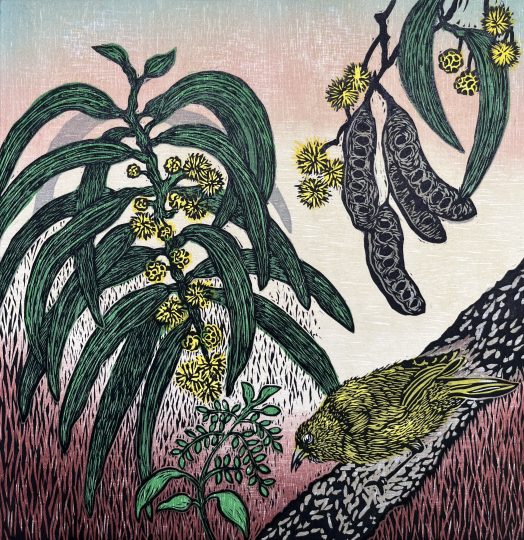
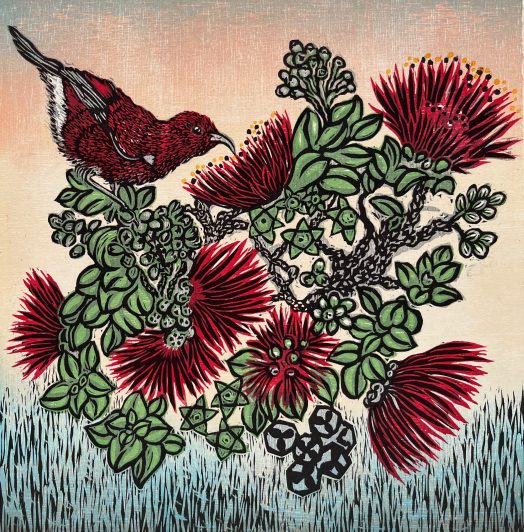
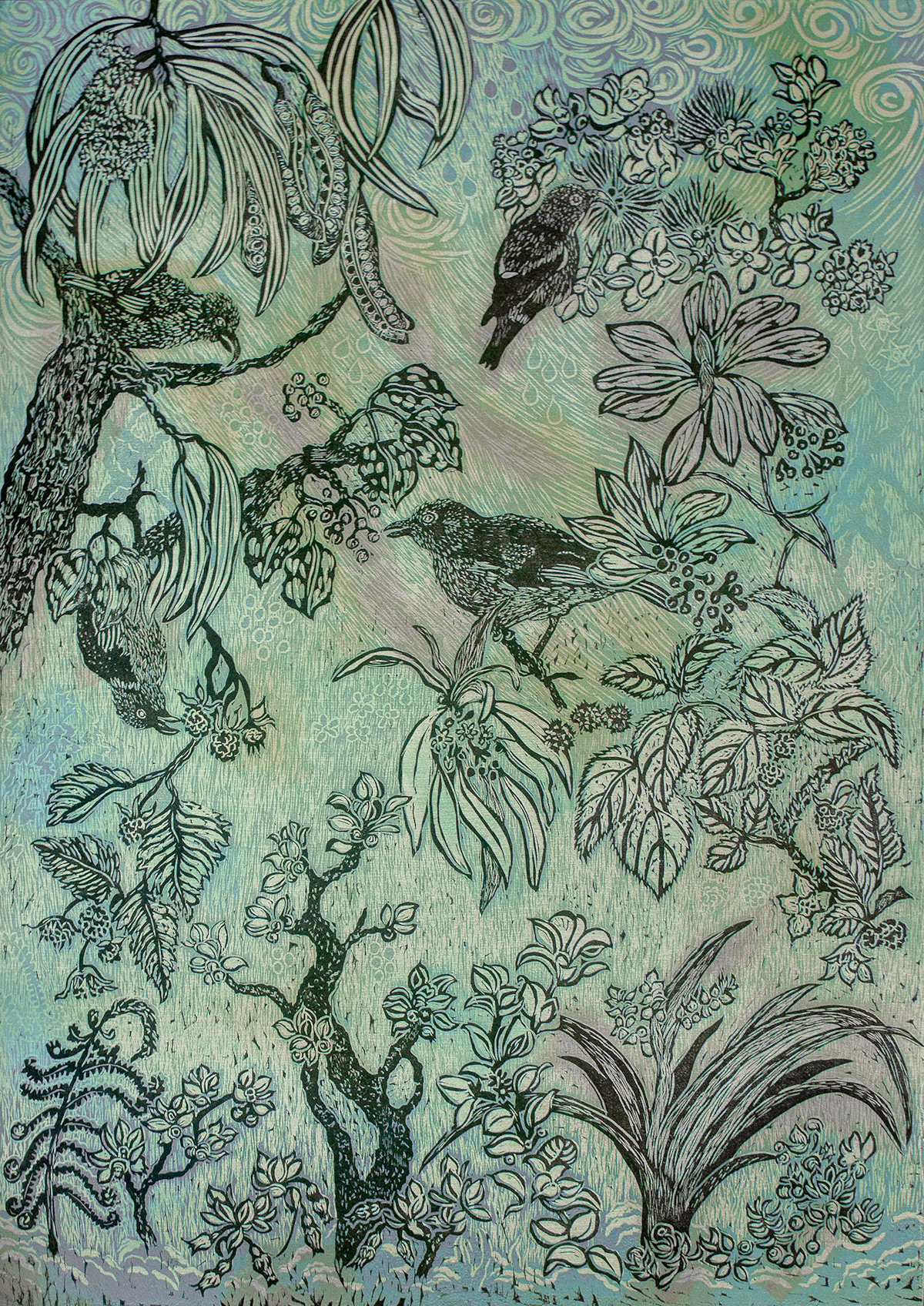
This woodcut print features our beautiful ʻŌmaʻo foraging with gusto among the ripening ʻĀkala in the month of April in the second kīpuka of the Puʻu ʻŌʻō Trail near Mauna Kea. ʻŌmaʻō is a fruit-eating bird who plays a vital role of sprinkling seeds throughout the forest, ensuring that the plants native to this ecosystem will continue to propagate, providing homes and food for so many other birds and insects. The ʻAkiapōlāʻau, a little yellow bird with a sickle- shaped beak is at upper left prying up bark and tweezing insects from their hiding places. We heard there was a nesting pair of ʻAkiapōlāʻau in the second kīpuka, and heard them calling, but never got a close up look. The iconic ʻIʻiwi, a flamboyantly territorial honeycreeper, is collecting nectar from ʻŌhiʻa lehua in the upper right corner.
As we hiked through the lush forest, the raucous call of the ʻŌmaʻo resounded through the canopy. I quickly realized that this might be because one of their favorite foods, the ʻĀkala, the Hīawaiian native raspberry, was available for an easy meal. My partner, Joe, is new to bird watching, but he is an excellent spotter and is impressively quiet in the forest. Quiet attracts birds. We wound our way off the trail into the underbrush and sat down to eat our lunch. This cold rainy day was not ideal for an outdoor picnic, but thatʻs what nature delivered. After a short time of silent sitting,ʻŌmaʻo began zipping through the understory around us, foraging with a palpable excitement. One intrepid bird shot straight through the forest toward us at eye level, veering up sharply 15 feet away. This display of aerial acrobatics was surprising. ʻŌmaʻo are sturdy, plump birds that can often be seen sitting serenely on a branch.
In my volunteer work on re-forestation projects with biologists and conservation organizations, the consistent story we hear is of environmental impacts on the birds and plants. According to “Extinct Birds of Hawaiʻi.” By Michael Walther, Hawaiʻi has already lost 77 bird species, giving us the sad distinction of “bird extinction capital of the world.”
Being in this remote forest ecosystem where every plant, bird and insect is interconnected and vital to this web of life always fills me with gratitude for this experience and the pain of heartbreak, knowing that some of these birds may not survive far into the future. This day the rare experience of being with ʻŌmaʻo avidly foraging lifted me into a feeling of illuminated joy.
Special mahalos to my partner Joe for being such a wonderful companion in nature, and to K. Kuulei Kanahele (Perreira-Keawekane), Hawaiian cultural practitioner, for advising me on a fitting title for this print, which she expands upon in her Cultural Statement. K. Kuulei Kanahele is a consultant that regularly assists individuals and organizations with the re-indigenization of their practices and systems. She is a third-generation farmer who comes from the Keawekane family of Panaʻewa, Waiākea, Hilo, Hawaiʻi.
Cultural Statement
Kuulei Kanahele (Perreira-Keawekane)
“He Milimili Kīhoʻihoʻi” is a term imbued with indigenous wisdom, which translates simply to “A Regenerative Affection”. Over the years, the terms “mili” and “milimili” were increasingly used to describe slow and sluggish unproductivity; this is evidence of the shift in perspective on the term through time. In older times, close and meaningful observation of place (otherwise known as “kilo”) was an integral part of survival for Hawaiʻi people; the ability to “milimili” – to take our time in nature to observe, connect with, and be curious of our natural systems – were part of a larger reality of interdependence between nature and humankind. Through the illegal occupation of the Hawaiian Kingdom Government, and the commodification of Hawaiʻi lands through the establishment of sugar and pineapple plantations, a sense of urgency was applied to the Hawaiian way of life. This demand over our time de-centered the importance of presence and relationality, and prioritized the monetization of time, demoralizing the “mili” and “milimili”, drawing a negative connotation to stillness and connection to the natural world. This print and the intentions that name it, aim to restore honor and value to a fond curiosity for the forest and her inhabitants, and to the accountability that humans must have to sustain her.
The term “Kīhoʻihoʻi” adds depth and ancience to the name of the print. The complete word itself doesn’t live in the Hawaiian Dictionary, but is a reference to a traditional chant found in the story of Hiʻiaka and Pele curated by Nathaniel B. Emerson, later revitalized by the work of the Edith Kanakaʻole Foundation (EKF) in their Kīhoʻihoʻi Kānāwai – Restoring Kānāwai for Island Stewardship document. The Guide presents the following: He Kīhoʻihoʻi Kānāwai: Here is the edict of regeneration – Greening of a new flow by Hiʻiaka, restoration of landscapes; when allowed the opportunity, land, ocean & kanaka return to health; it is the law of regeneration.” In a video presentation created for the Mauna Kea Stewardship and Oversight Authority (MKSOA), Dr. Pualani Kanakaʻole shares about the kīhoʻihoʻi kanawai. She says,
The law of regeneration is that we need to continue our own generation of kanaka (people), we need to see that the generations of native trees and birds continue, that the insects that live in these areas continue because they’re the food for the birds. The law of regeneration is that when we go out, there’s a sense of reciprocation. If you go back to the Kumulipo in the first 2 lines, ʻO ke ao i kāhuli wela ka hōnua – thatʻs about the lava that makes our earth hot, and when it gets hot like that, it clouds the sky – ʻo ke ao i kūkaʻi aka ka lā, it hides the sun – it returns water to the space above, turning it into clouds, and that cloud system will return the water back to us. The kīhoʻihoʻi kānāwai is that we give, and the land gives back.
So together, the name He Milimili Kīhoʻihoʻi is a singular term that references a fond affection for regenerational accountability to land. It works to bring name to an art of being “called in” to the wisdom that is present in the stillness of the forest, and in the moments between Andrea and Joe – where the birds were lively and in close relation to the fruitfulness of their home. The term names our fondness and curiosity for ʻāina (the land that feeds us physically and spiritually), and for the sense of duty we must sustain to care for the forest people present in the image – those that are the birds: the ʻAkiapōlāʻau, the ʻŌmaʻo, the ʻIʻiwi – and the plants: the koa, ʻōhiʻa lehua, kōlea lau nui, naio, the māmaki, ʻākala, paʻiniu, kāwaʻu, the ʻōhelo ʻai, the pilo, the laukahi, the ʻōlapa.
I am so grateful for the time I was able to share with Andrea, to listen to her heart of affection and activation for Hawaiʻi and her people – human, forest, and beyond, and to share in my experiences on the Hawaiian Language and culture, to find the words that best capture her message. I am thankful for the beauty of her works, which are a call to action for us to pause in the stillness and affection of nature in order to preserve the wealth and abundance of our natural world, in perpetuity for the generations to come – He Milimili Kīhoʻihoʻi.


Holualoa, Hawaii 96725
808-345-0907
andrea@andreapro.com
© 2026 Andrea Pro. All artwork on this website is copyrighted and not allowed to be reproduced without permission. Partners and Licensing | Terms & Conditions | Shipping & Returns Policy | Privacy Policy
SEO, WP Dev by Malama.


Sign up for my email list now and receive this greeting card download to print/share with your friends and family.
I’ll never share your information with anyone and you can unsubscribe at any time.